Let us look at the first class of multilinear maps; the bilinear maps.
We want to study bilinear maps. The notion of "study" will have different meanings as we move forward (or backward) in the course.
Let \(V,W,T\) be vector spaces and \(\varphi:V\times W\rightarrow T\) be a bilinear map.
The feeling that "we are good at linear algebra" suggests us to ask the question :
Can we associate a linear map for the bilinear map \(\varphi:V\times W\rightarrow T\), so that (almost) all the information in the bilinear map is included in the linear map; in which case we can take some help from the (very little) linear algebra we knew?
We need to make it clear :
Are we going to associate a linear map \(P\rightarrow M\) for each bilinear map \(\varphi:V\times W\rightarrow T\)?
It would be useful to remind ourselves the phrase "less luggage more comfort".
When trying to construct a new structure, it is good to start with least luggage. If we consider \(V\times W\rightarrow T\) as the data, we will have four components in that: three vector spaces \(V, W,T\) and a map \(V\times W\rightarrow T\).
Vector spaces as such was not of issue for us; not in linear algebra. It is the product that is creating a discomfort for us. The product comes with just two vector spaces \(V,W\) and "nothing else".
So, we ask the question again, with a small change:
Can we associate a single vector space \(P\) for the product \(V\times W\) (note that the word product starts with letter p), hoping that, it will help us to construct a linear map out of the bilinear map?
One can of course, look at the inclusion map \(V\rightarrow V\times W, W\rightarrow V\times W\) and consider the compositions \(V\rightarrow V\times W\rightarrow T, W\rightarrow V\times W\rightarrow T\); giving us two linear maps \(V\rightarrow T\) and \(W\rightarrow T\).
This is not what we want. We want one single vector space, one single linear map to gather the information of the bilinear map.
Let us recall some of the constructions you have seen in your previous courses.
Construction of a quotient space \(X/\sim\) from a topological space \(X\). We may not even acknowledge, but, the data of quotient space is not just a topological space, it is a topological space along with a map \(X\rightarrow X/\sim\). This is because the topology on the set \(X/\sim\) is constructed from topology on \(X\).
Construction of a quotient space \(V/W\) from a vector space \(V\). As in the above case, the data of quotient space is not just a vector space, it is a vector space along with a map $V\rightarrow V/W$. This is because the vector space structure on the set \(V/W\) is constructed from the vector space structure on \(V\).
In similar way, in our construction, the data should not be just a vector space \(P\), it should be a vector space \(P\) along with a map \(V\times W\rightarrow P\). In case of topological space, any map between two topological spaces is understood to be a continuous map. Similarly, in case of vector spaces, any map between two vector spaces is understood to be a linear map. The last sentence is not quite correct; as in this very setup we are discussing about bilinear maps between two from a product vector space to another vector space. This raises the following question.
Question : Do we want this map \(V\times W\rightarrow P\) to be a linear map or a bilinear map?
It looks like asking for a bilinear map is the opposite of what we should be doing. It is due to bilinear maps we are searching for a comfortable play ground where we can play making use of our previous experience in the play ground of linear algebra. But, it is not what we are after.
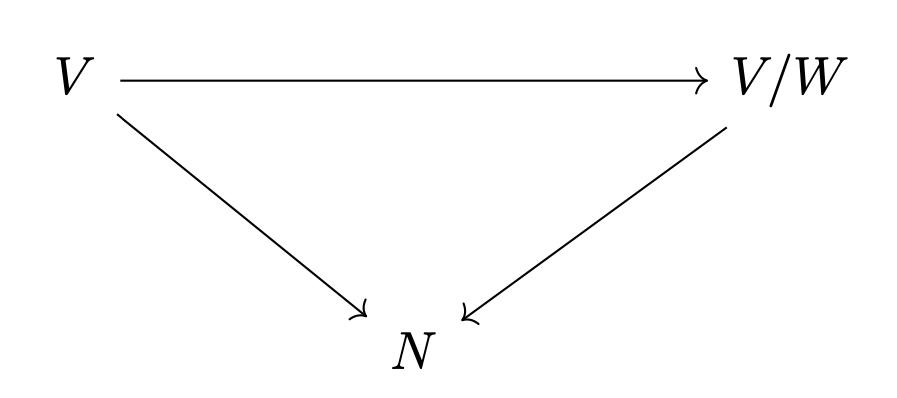
Let us see what was the property of quotients maps mentioned above. The basic property of the map \(V\rightarrow V/W\) is that, every element in \(W\) is mapped to the zero element of \(V/W\). Not just that. If we take any other linear map \(V\rightarrow N\) in which every element in \(W\) is mapped to the zero element in \(N\), then, we can get a linear map \(V/W\rightarrow N\) giving
a commutative diagram.
The same can be taken as a reference point for our construction. In our case, we are looking for one single bilinear map, \(V\times W\rightarrow P\) that works as a necessary passage for all bilinear maps from \(V\times W\). More precisely, we have the following description.
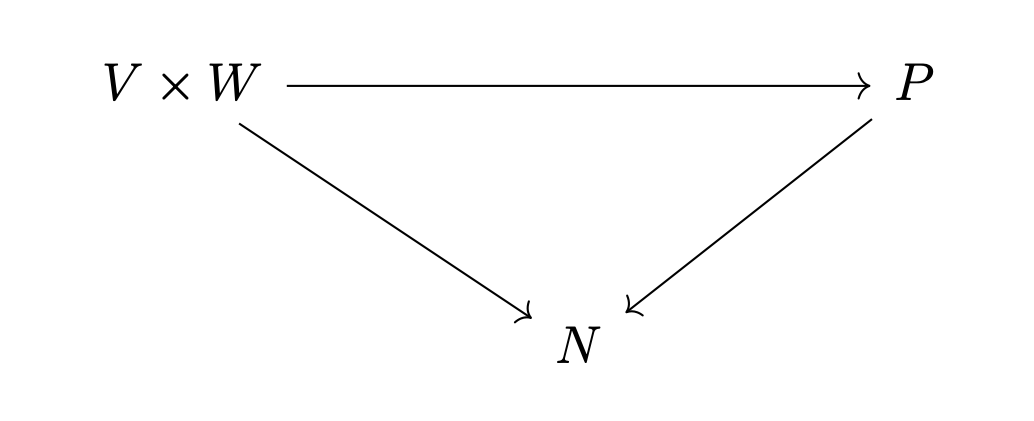
A vector space \(P\) along with a bilinear map \(V\times W\rightarrow P\) such that, for any other vector space \(N\) and any other bilinear map \(V\times W\rightarrow N\) there exists a linear map \(P\rightarrow N\) giving
a commutative diagram.
There are many questions.
Does such space always exists? Is it unique? Is the map \(P\rightarrow N\) unique? Does it have a name?
The best we can do in this post is to answer the last question.