Before we move to the notion of "a model structure on a category", we need to recall (or introduce) some definitions.
Definition : Let \(\mathcal{C}\) be a category. An object \(X\) of \(\mathcal{C}\) is said to be a retract of an object \(\mathcal{C}\) if there exists arrows \(X\xrightarrow{f} Y\xrightarrow{g} X\) such that, the composition \(g\circ f:X\rightarrow X\) is equal to the identity arrow \(1_X:X\rightarrow X\).
Definition : Let \(\mathcal{C}\) be a category. We define the morphism category of \(\mathcal{C}\), denoted by \(\text{Map}(\mathcal{C})\) whose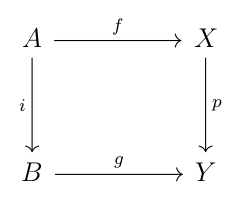 there exists an arrow \(h:B\rightarrow X\) such that \(h\circ i=f\) and \(p\circ h=g\).
Definition : Let \(\mathcal{C}\) be a category. A model structure on \(\mathcal{C}\) consists of the following data :
there exists an arrow \(h:B\rightarrow X\) such that \(h\circ i=f\) and \(p\circ h=g\).
Definition : Let \(\mathcal{C}\) be a category. A model structure on \(\mathcal{C}\) consists of the following data :
- objects are the arrows of \(\mathcal{C}\),
- morphisms are commutative diagrams in \(\mathcal{C}\).
there exists an arrow \(h:B\rightarrow X\) such that \(h\circ i=f\) and \(p\circ h=g\).
Definition : Let \(\mathcal{C}\) be a category. A model structure on \(\mathcal{C}\) consists of the following data :- a subcategory of \(\mathcal{C}\) called “weak equivalences”,
- a subcategory of \(\mathcal{C}\) called “fibrations”,
- a subcategory of \(\mathcal{C}\) called “cofibrations”,
- If \(f,g\) are morphisms of \(\mathcal{C}\) such that \(gf\) is defined and two of \(f,g,gf\) are "weak equivalences" then so is the third.
- A retract of a "weak equivalece" is a "weak equivalence".
- A retract of a "fibration" is a "fibration".
- A retract of a "cofibration" is a "cofibration".
- factorizing property (part \(1\)) of arrows of \(\mathcal{C}\) : for each \(f\) in \(\text{Mor}(\mathcal{C})\), there exists a cofibration \(i\) and a traivial fibration \(q\) such that \(f=qi\).
- factorizing property (part \(2\)) of arrows of \(\mathcal{C}\) : for each \(f\) in \(\text{Mor}(\mathcal{C})\), there exists a fibration \(p\) and a trivial cofibration \(j\) such that \(f=pj\).
- Any commutative diagram of the type
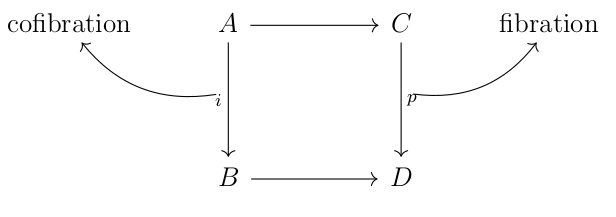 has lifting property if either \(i\) or \(p\) is a "weak equivalence".
- all small limits,
- all small colimits,
- a model structure in \(\mathcal{C}\).
- Let \(\mathcal{C}\) and \(\mathcal{D}\) be model categories. Defining the collection of fibrations (cofibrations, weak equivalences) as pairs \((f,g)\) where both \(f\) and \(g\) are fibrations (cofibrations, weak equivalences) defined a model structure on the product category \(\mathcal{C}\times \mathcal{D}\). This model category is called the product model category produced from model categories \(\mathcal{C}\) and \(\mathcal{D}\).