Let \(F:\mathcal{I}\rightarrow \mathcal{C}\) is a functor. This is also called as diagram indexed by \(\mathcal{I}\).
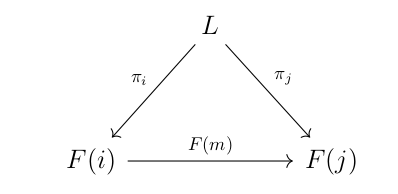
By the Limit of this diagram, we mean an object (universal) \(L\) of \(\mathcal{C}\) and a collection of arrows (universal again) \(\pi_i:L\rightarrow F(i)\) such that, for each arrow \(m:i\rightarrow j\) in \(\mathcal{I}\) the following diagram is commutative.
 This is usually denoted by \(\varprojlim_{\mathcal{I}}F(i)\) or simply by \(\varprojlim_{\mathcal{I}}F\).
Fixing an object \(X\) in \(\mathcal{C}\), I want to prove that
This is usually denoted by \(\varprojlim_{\mathcal{I}}F(i)\) or simply by \(\varprojlim_{\mathcal{I}}F\).
Fixing an object \(X\) in \(\mathcal{C}\), I want to prove that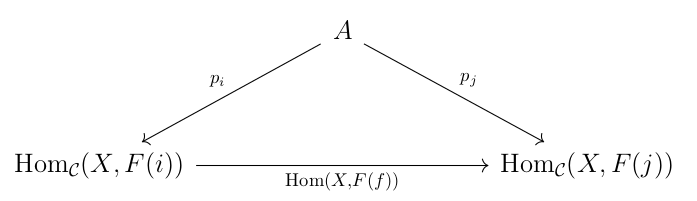 To prove that \(\text{Hom}_{\mathcal{C}}(X,L)\) is equal to \(\varprojlim_{\mathcal{I}}(\text{Hom}_{\mathcal{C}}(X,F(i)))\) it suffices to prove that there exists unique arrow \(p:A\rightarrow \text{Hom}_{\mathcal{C}}(X,L)\) such that the following diagram is commutative.
 So, we define an arrow \(p:A\rightarrow \text{Hom}_{\mathcal{C}}(X,L)\) i.e., given \(a\in A\) we define arrow \(p(a):X\rightarrow L\) in \(\mathcal{C}\). How to one get such arrow? See above diagram.
For each \(a\in A\), we have \(p_i(a):X\rightarrow F(i)\) such that \(F(m)\circ p_i(a)=p_j(a)\) giving following diagram which gives an arrow \(X\rightarrow L\) by universal property
So, we define an arrow \(p:A\rightarrow \text{Hom}_{\mathcal{C}}(X,L)\) i.e., given \(a\in A\) we define arrow \(p(a):X\rightarrow L\) in \(\mathcal{C}\). How to one get such arrow? See above diagram.
For each \(a\in A\), we have \(p_i(a):X\rightarrow F(i)\) such that \(F(m)\circ p_i(a)=p_j(a)\) giving following diagram which gives an arrow \(X\rightarrow L\) by universal property
 This is the \(p(a):X\rightarrow L\) that we associate for each \(a\in L\).
This gives the map \(p:A\rightarrow \text{Hom}_{\mathcal{C}}(X,L)\) satisfying conditions mentioned above. Thus, we have
This is the \(p(a):X\rightarrow L\) that we associate for each \(a\in L\).
This gives the map \(p:A\rightarrow \text{Hom}_{\mathcal{C}}(X,L)\) satisfying conditions mentioned above. Thus, we have
This is usually denoted by \(\varprojlim_{\mathcal{I}}F(i)\) or simply by \(\varprojlim_{\mathcal{I}}F\).
Fixing an object \(X\) in \(\mathcal{C}\), I want to prove that\(\varprojlim_{\mathcal{I}}(\text{Hom}_{\mathcal{C}}(X,F(i))) =\text{Hom}_{\mathcal{C}}(X,\varprojlim_{\mathcal{I}}F(i))\)
i.e., an isomorphism\(\varprojlim_{\mathcal{I}}(\text{Hom}_{\mathcal{C}}(X,F(i))) =\text{Hom}_{\mathcal{C}}(X,L)\)
Let \((A,(p_i))\) be cone for the functor \(\mathcal{I}\rightarrow \text{Set}\) given by \(i\mapsto \text{Hom}_{\mathcal{C}}(X,F(i))\) i.e., we have following commutative diagrams
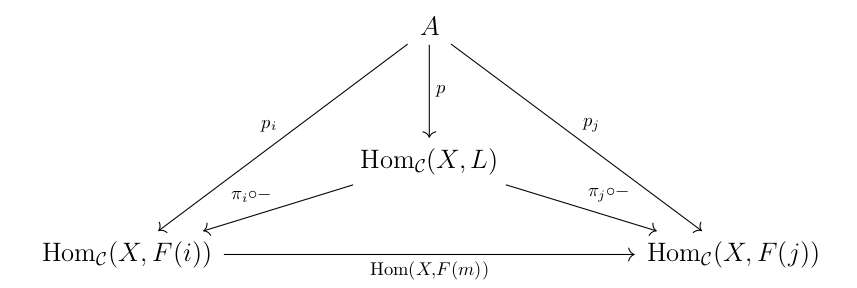
To prove that \(\text{Hom}_{\mathcal{C}}(X,L)\) is equal to \(\varprojlim_{\mathcal{I}}(\text{Hom}_{\mathcal{C}}(X,F(i)))\) it suffices to prove that there exists unique arrow \(p:A\rightarrow \text{Hom}_{\mathcal{C}}(X,L)\) such that the following diagram is commutative.
So, we define an arrow \(p:A\rightarrow \text{Hom}_{\mathcal{C}}(X,L)\) i.e., given \(a\in A\) we define arrow \(p(a):X\rightarrow L\) in \(\mathcal{C}\). How to one get such arrow? See above diagram.
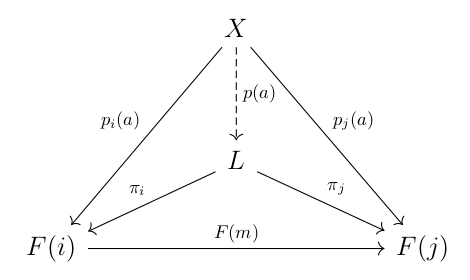
For each \(a\in A\), we have \(p_i(a):X\rightarrow F(i)\) such that \(F(m)\circ p_i(a)=p_j(a)\) giving following diagram which gives an arrow \(X\rightarrow L\) by universal property
This is the \(p(a):X\rightarrow L\) that we associate for each \(a\in L\).
This gives the map \(p:A\rightarrow \text{Hom}_{\mathcal{C}}(X,L)\) satisfying conditions mentioned above. Thus, we have\(\varprojlim_{\mathcal{I}}(\text{Hom}_{\mathcal{C}}(X,F(i))) =\text{Hom}_{\mathcal{C}}(X,L)=\text{Hom}_{\mathcal{C}}(X,\varprojlim_{\mathcal{I}}F(i))\)