Let \(G\) be a Lie group and \(\pi_P:P\rightarrow M, \pi_Q:Q\rightarrow M\) be principal \(G\) bundles. Then, any \(G\)-equivariant map \(f:P\rightarrow Q\) inducing identity on \(M\) is a diffeomorphism.
The same holds when we have Lie groupoids instead of Lie groups.
Let \(\mathcal{G}\) be a Lie groupoid and \(P\rightarrow M, Q\rightarrow M\) be principal \(\mathcal{G}\) bundles. Then, any \(\mathcal{G}\)-equivariant map \(f:P\rightarrow Q\) inducing identity on \(M\) is a diffeomorphism.
Above result is very basic thing when defining a stack associated for a Lie groupoid \(\mathcal{G}\). Given a Lie groupoid \(\mathcal{G}\), we define a category fibered in groupoids \(B\mathcal{G}\rightarrow \text{Man}\) by associating for each manifold \(U\) a category \(B\mathcal{G}(U)\) whose objects are principal \(\mathcal{G}\) bundles whose base space is \(U\) i.e., of the form \(P\rightarrow U\) and morphism from an object \(P\rightarrow U\) to another object \(Q\rightarrow U\) is a \(\mathcal{G}\)-equivariant map \(P\rightarrow Q\) that induces \(Id:U\rightarrow U\) on base space of those principal bundles. Thus, to say \(B\mathcal{G}(U)\) is a Lie groupoid, we need to prove that every arrow \((P\rightarrow U)\rightarrow (Q\rightarrow U)\) is an isomorphism which is what we are trying to prove.
Let us see the proof for the case of Lie groups. See the set up as following diagram. 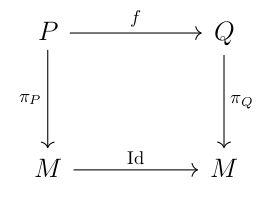 Let \(p,p'\in P\) are such that \(f(p)=f(p')\), thus, \(\pi_Q(f(p))=\pi_Q(f(p'))\). As \(\pi_Q\circ f=\pi_P\), we have \(\pi_P(p)=\pi_P(p')\) i.e., there exists \(g\in G\) such that \(p'=p.g\). Thus, \(f(p')=f(pg)\). As \(f\) is \(G\)-equivariant, we have \(f(pg)=f(p)g\). Thus, we have \(f(p')=f(p)g\). As the action of \(G\) on \(Q\) is free, \(f(p')=f(p),f(p')=f(p)g\) implies \(g=1\). Thus, \(p'=p\). So, \(f\) is one to one mapping.
Let \(q\in Q\). We have \(\pi_Q(q)\in M\). As \(\pi_P\) is surjective, there exists \(p\in P\) such that \(\pi_P(p)=\pi_Q(q)\). As \(\pi_Q\circ f=\pi_P\), we have \(\pi_Q(f(p))=\pi_P(p)=\pi_Q(q)\). As \(\pi_Q(f(p))=\pi_Q(q)\), there exists \(g\in G\) such that \(f(p)g=q\). As \(f\) is \(G\)-equivariant, we have \(f(p)g=f(pg)\). Thus, we have \(q=f(pg)\) which implies that \(f\) is an onto mapping.
Suppose that \(\pi_P:P\rightarrow M\) is trivial \(G\) bundle, not for simplicity but because every principal \(G\) bundle is locally trivial and diffeomorphism is something that needs to be checked locally.
As \(\pi_P:P\rightarrow M\) is trivial, it has a global section for \(\pi_P\) i.e., a smooth map \(\sigma:M\rightarrow P\) such that \(\pi_P\circ \sigma=1\). This gives a trivialization \(M\times G\xrightarrow{\Phi} P\) i.e., an isomorphism. Consider the cimposition \(f\circ \pi:M\rightarrow Q\). This is again a smooth map such that
Let \(p,p'\in P\) are such that \(f(p)=f(p')\), thus, \(\pi_Q(f(p))=\pi_Q(f(p'))\). As \(\pi_Q\circ f=\pi_P\), we have \(\pi_P(p)=\pi_P(p')\) i.e., there exists \(g\in G\) such that \(p'=p.g\). Thus, \(f(p')=f(pg)\). As \(f\) is \(G\)-equivariant, we have \(f(pg)=f(p)g\). Thus, we have \(f(p')=f(p)g\). As the action of \(G\) on \(Q\) is free, \(f(p')=f(p),f(p')=f(p)g\) implies \(g=1\). Thus, \(p'=p\). So, \(f\) is one to one mapping.
Let \(q\in Q\). We have \(\pi_Q(q)\in M\). As \(\pi_P\) is surjective, there exists \(p\in P\) such that \(\pi_P(p)=\pi_Q(q)\). As \(\pi_Q\circ f=\pi_P\), we have \(\pi_Q(f(p))=\pi_P(p)=\pi_Q(q)\). As \(\pi_Q(f(p))=\pi_Q(q)\), there exists \(g\in G\) such that \(f(p)g=q\). As \(f\) is \(G\)-equivariant, we have \(f(p)g=f(pg)\). Thus, we have \(q=f(pg)\) which implies that \(f\) is an onto mapping.
Suppose that \(\pi_P:P\rightarrow M\) is trivial \(G\) bundle, not for simplicity but because every principal \(G\) bundle is locally trivial and diffeomorphism is something that needs to be checked locally.
As \(\pi_P:P\rightarrow M\) is trivial, it has a global section for \(\pi_P\) i.e., a smooth map \(\sigma:M\rightarrow P\) such that \(\pi_P\circ \sigma=1\). This gives a trivialization \(M\times G\xrightarrow{\Phi} P\) i.e., an isomorphism. Consider the cimposition \(f\circ \pi:M\rightarrow Q\). This is again a smooth map such that
Let \(p,p'\in P\) are such that \(f(p)=f(p')\), thus, \(\pi_Q(f(p))=\pi_Q(f(p'))\). As \(\pi_Q\circ f=\pi_P\), we have \(\pi_P(p)=\pi_P(p')\) i.e., there exists \(g\in G\) such that \(p'=p.g\). Thus, \(f(p')=f(pg)\). As \(f\) is \(G\)-equivariant, we have \(f(pg)=f(p)g\). Thus, we have \(f(p')=f(p)g\). As the action of \(G\) on \(Q\) is free, \(f(p')=f(p),f(p')=f(p)g\) implies \(g=1\). Thus, \(p'=p\). So, \(f\) is one to one mapping.
Let \(q\in Q\). We have \(\pi_Q(q)\in M\). As \(\pi_P\) is surjective, there exists \(p\in P\) such that \(\pi_P(p)=\pi_Q(q)\). As \(\pi_Q\circ f=\pi_P\), we have \(\pi_Q(f(p))=\pi_P(p)=\pi_Q(q)\). As \(\pi_Q(f(p))=\pi_Q(q)\), there exists \(g\in G\) such that \(f(p)g=q\). As \(f\) is \(G\)-equivariant, we have \(f(p)g=f(pg)\). Thus, we have \(q=f(pg)\) which implies that \(f\) is an onto mapping.
Suppose that \(\pi_P:P\rightarrow M\) is trivial \(G\) bundle, not for simplicity but because every principal \(G\) bundle is locally trivial and diffeomorphism is something that needs to be checked locally.
As \(\pi_P:P\rightarrow M\) is trivial, it has a global section for \(\pi_P\) i.e., a smooth map \(\sigma:M\rightarrow P\) such that \(\pi_P\circ \sigma=1\). This gives a trivialization \(M\times G\xrightarrow{\Phi} P\) i.e., an isomorphism. Consider the cimposition \(f\circ \pi:M\rightarrow Q\). This is again a smooth map such that\(\pi_Q\circ (f\circ \sigma)=(\pi_Q\circ f)\circ \sigma=\pi_P\circ \sigma=1\)
i.e., the composition \(f\circ \sigma:M\rightarrow Q\) is a global section for \(\pi_Q:Q\rightarrow M\). This again gives a trivialization \(Q\xrightarrow{\Psi} M\times G\). Check that \(\Psi\circ f\circ \Phi=1\), which is fun (no difficult) to check. As both \(\Psi, \Phi\) are diffeomorphism, \(\Psi\circ f\circ \Phi=1\) says that \(f=\Psi^{-1}\circ \Phi^{-1}\). Being a composition of diffeomorphisms \(\Psi^{-1}\) and \(\Phi^{-1}\), the map \(f:P\rightarrow Q\) is a diffeomorphism. If you consider local trivialization \(U\times G\rightarrow \pi^{-1}(U)\), above procedure says that \(f|_{\pi^{-1}(U)}\) is a diffeomorphism. See that \(P\) is covered by \(\pi^{-1}(U)\). Thus, \(f\) is a diffeomorphism.