- (Pull back exists and gives an open cover) Suppose \(\{U_i\rightarrow M\}\) is an open cover for \(M\) and \(\pi:V\rightarrow M\) is a smooth map. Then, \(\{\pi^{-1}(U_i) \rightarrow V\}\) is a cover for \(V\).
- (Diffeomorphisms gives open cover) For any manifold \(M\), \(M\) itself is considered as an open cover \(\{M\rightarrow M\}\). More generally, for any diffeomorphism \(M'\rightarrow M\), \(\{M'\rightarrow M\}\) is considered as an open cover.
- (Open cover of open cover is an open cover) Let \(\{U_\alpha\rightarrow U\}\) be an open cover for \(U\) i.e., \(\bigcup_{\alpha} U_\alpha=U\). Suppose \(\{V_{\alpha\beta}\rightarrow U_\alpha\}\) is an open cover for \(U_\alpha\) for each \(\alpha\) i.e., \(\bigcup_{\beta}V_{\alpha\beta}=U_\alpha\). Then, \(\bigcup_{\alpha\beta}V_{\alpha\beta}=U\) i.e., \(\{V_{\alpha\beta}\rightarrow U\}\) is an open cover for \(U\).
- (Pullbacks exists and gives a cover) Suppose \(\{U_i\rightarrow U\}\in \mathcal{W}\) and \(\pi:V\rightarrow U\) be an arrow. Then, the pull back \(U_i\times_UV\) exists (as an object in \(\mathcal{C}\)) and \(\{U_i\times_UV \rightarrow V\}\) is a cover for \(V\).
- (Isomorphisms gives an open cover) Suppose \(V\in \mathcal{C}_0\) and \(V\rightarrow U\) is an isomorphism in \(\mathcal{C}\) then, \(\{V\rightarrow U\}\in \mathcal{W}\).
- (cover of a cover is a cover) Suppose \(\{U_\alpha\rightarrow U\}\in \mathcal{W}\) and \(\{U_{\alpha\beta}\rightarrow U_\alpha\}\in \mathcal{W}\) for each \(\alpha\). Then, the collection of compositions \(\{U_{\alpha\beta}\rightarrow U_\alpha\rightarrow U\}\in \mathcal{W}\).
- Given an object \(U\) of \(\mathcal{C}\) we have what is called fibre of \(U\) in \(\mathcal{D}\) usually denoted by \(\mathcal{D}(U)\).
- Given an object \(U\) of \(\mathcal{C}\) and a cover \(\{U_i\rightarrow U\}\) (i.e., it belongs to \(\mathcal{W}\)) we have what is called descent category associated to the cover \(\{U_i\rightarrow U\}\), usually denoted by \(\mathcal{D}(\{U_i\rightarrow U\})\).
Definition : Let \(\mathcal{C}\) be a category with Grothendieck topology \(\mathcal{W}\). A category fibered in groupoids \(\mathcal{D}\rightarrow \mathcal{C}\) is said to be a stack over \(\mathcal{C}\) if, for every object \(U\) of \(\mathcal{C}\) and every cover \(\{U_i\rightarrow U\}\), the functor \(\mathcal{D}(U)\rightarrow \mathcal{D}(\{U_i\rightarrow U\})\) is an equivalence of categories.
The fibre categroy \(\mathcal{D}(U)\) is a category whose objects are that of \(\mathcal{D}\) which map to \(U\) under \(F\) i.e.,\(\mathcal{D}(U)_0=\{V\in \mathcal{D}_0:F(V)=U\}\).
Given \(V,V'\in \mathcal{D}(U)_0\), a morphism \(V\rightarrow V'\) in \(\mathcal{D}(U)\) is a morphism in \(\mathcal{D}\) that maps to \(id:U\rightarrow U\) under \(F\) i.e.,\(\mathcal{D}(U)_1=\{V\xrightarrow{f} V\in \mathcal{D}:F(f:V\rightarrow V')=id:U\rightarrow U\}\).
To define descent category \(\mathcal{D}(\{U_i\xrightarrow{\sigma_i} U\})\) associated to a cover \(\{U_i\xrightarrow{\sigma_i}U\}\) we need to fix some notations. We have already mentioned that, pull backs exists (in the definition of Grothendieck topology). Thus, \(U_i\times_U U_j\) exists and we denote \(U_i\times_U U_j\) by \(U_{ij}\). We have following pull back diagram.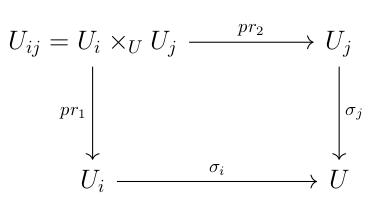 We have following diagram for \(U_{ijk}=U_i\times_U U_j\times_U\times_U U_k\).
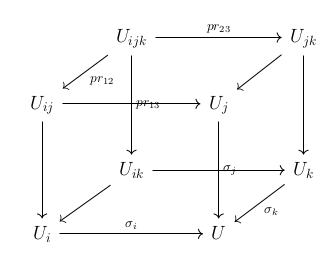 Note that functor \(F:\mathcal{D}\rightarrow \mathcal{C}\) gives a functor \(f^*:\mathcal{D}(V)\rightarrow \mathcal{D}(U)\) for each arrow \(f:U\rightarrow V\) in \(\mathcal{C}\). It is easier to guess what this map has to be than to write down what this map is. So, we skip the description of this functor. Thus, for \(pr_1:U_{ij}\rightarrow U_i\) we have \(pr_1^*:\mathcal{D}(U_i)\rightarrow \mathcal{D}(U_{ij})\) and for \(pr_2:U_{ij}\rightarrow U_j\) we have functor \(pr_2^*:\mathcal{D}(U_j)\rightarrow \mathcal{D}(U_{ij})\). We have following diagram
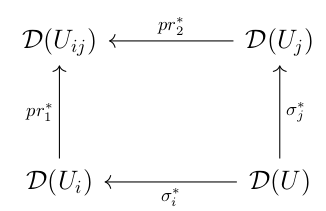 The descent category \(\mathcal{D}(\{U_i\xrightarrow{\sigma_i}U\})\) is a category whose objects are a collection \((\{\xi_i\},\{\phi_{ij}\})\) where \(\xi_i\in \mathcal{D}(U_i)\) and \(\phi_{ij}:pr_1^*(\xi_j)\rightarrow pr_2^*(\xi_i)\) is an isomorphism in \(\mathcal{D}(U_{ij})\) satisfying following cocylce condition on \(U_{ijk}\),
\(pr_{13}^*(\phi_{ik})=pr_{12}^*(\phi_{ij})\circ pr_{23}^*(\phi_{j}):pr_3^*(\xi_k)\rightarrow pr_1^*(\xi_i)\).
This can be seen as following diagram.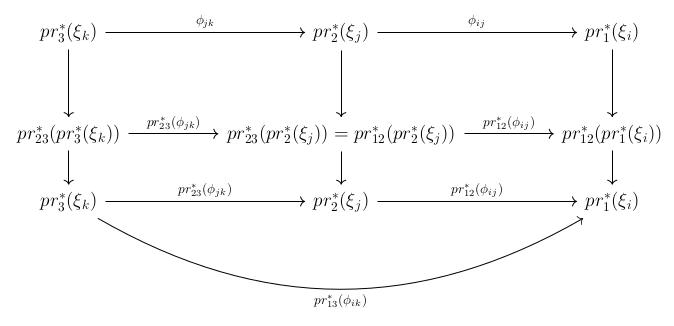 One must observe that
\(pr_{23}^*(pr_3^*(\xi_k))=pr_3^*(\xi_k), pr_{23}^*(pr_2^*(\xi_j))=pr_2^*(\xi_j)=pr_{12}^*(pr_2^*(\xi_j))\) and \(pr_{12}^*(pr_1^*(\xi_k))=pr_1^*(\xi_i)\).
For \((\{\xi_i\},\{\phi_{ij}\}),(\{\eta_i,\psi_{ij}\})\) in \(\mathcal{D}(\{U_i\rightarrow U\})_0\), an arrow \((\{\xi_i\},\{\phi_{ij}\})\xrightarrow{\alpha} (\{\eta_i,\psi_{ij}\})\) is a collection of arrows \(\alpha_i:\xi_i\rightarrow \eta_i\) in \(\mathcal{D}(U_i)\) such that\(pr_1^*(\alpha_i):pr_1^*(\xi_i)\rightarrow pr_1^*(\eta_i)\) and \(pr_2^*(\alpha_j):pr_2^*(\xi_j)\rightarrow pr_2^*(\eta_j)\)
are compatible with\(\phi_{ij}:pr_2^*(\xi_j)\rightarrow pr_1^*(\xi_i)\) and \(\psi_{ij}:pr_2^*(\eta_j)\rightarrow pr_1^*(\eta_i)\)
giving following commutative diagram.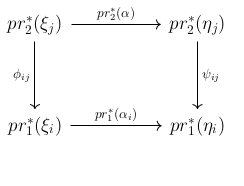 Now, we can describe the obvious functor \(\mathcal{D}(U)\rightarrow \mathcal{D}(\{U_i\rightarrow U\})\). An object \(\xi\in \mathcal{D}(U)\) is mapped to \((\{\xi_i\},\{\phi_{ij}\})\) where \(\xi_i=\sigma_i^*(\xi)\). For \(i,j\) we have \(pr_1^*:\mathcal{D}(U_i)\rightarrow \mathcal{D}(U_{ij})\) and \(pr_2^*:\mathcal{D}(U_i)\rightarrow \mathcal{D}(U_{ij})\). See that \(pr_1^*(\xi_i)=pr_1^*(\sigma_i^*(\xi))=(pr_1\circ \sigma)^*(\xi)\) is same as that of (there exists unique isomorphism) \(pr_2^*(\xi_j)=pr_2^*(\sigma_j^*(\xi))=(pr_2\circ \sigma)^*(\xi)\) as \(pr_2\circ \sigma=pr_1\circ \sigma\). Thus, there is a unique isomorphsim \(pr_2^*(\xi_j)\rightarrow pr_1^*(\xi_i)\) which we denote by \(\phi_{ij}:pr_2^*(\xi_j)\rightarrow pr_1^*(\xi_i)\). This gives functor \(\mathcal{D}(U)\rightarrow \mathcal{D}(\{U_i\rightarrow U\})\) at the level of objects. It is not difficult to see the functor at the level of morphisms. We skip that.
The condition for a category fibred in groupoids \(\mathcal{D}\rightarrow \mathcal{C}\) to be a stack over \(\mathcal{C}\) is that the functor \(\mathcal{D}(U)\rightarrow \mathcal{D}(\{U_i\rightarrow U\})\) is an equivalence of categories i.e., it is essentially surjective and the map \(\text{Hom}_{\mathcal{D}(U)}(\xi,\xi')\rightarrow \text{Hom}_{\mathcal{D}(\{U_i\rightarrow U\})}((\xi_i,\phi_{ij}),(\xi_i',\phi_{ij}'))\) is a bijection.
As \(\mathcal{D}(U)\rightarrow \mathcal{D}(\{U_i\rightarrow U\})\) is essentially surjective, it means, given a collection \(\xi_i\in \mathcal{D}(U_i)\) together with isomorphisms \(\phi_{ij}:pr_2^*(\xi_j)\rightarrow pr_1^*(\xi_i)\) satisfying cocylce condition mentioned above, there exists an element \(\xi\in \mathcal{D}(U)\) that maps to (there is an isomorphism to) \((\{\xi_i\},\{\phi_{ij}\})\). This condition is called as gluing objects.
The other condition is that for \(\xi,\eta\in \mathcal{D}(U)\) the map
Now, we can describe the obvious functor \(\mathcal{D}(U)\rightarrow \mathcal{D}(\{U_i\rightarrow U\})\). An object \(\xi\in \mathcal{D}(U)\) is mapped to \((\{\xi_i\},\{\phi_{ij}\})\) where \(\xi_i=\sigma_i^*(\xi)\). For \(i,j\) we have \(pr_1^*:\mathcal{D}(U_i)\rightarrow \mathcal{D}(U_{ij})\) and \(pr_2^*:\mathcal{D}(U_i)\rightarrow \mathcal{D}(U_{ij})\). See that \(pr_1^*(\xi_i)=pr_1^*(\sigma_i^*(\xi))=(pr_1\circ \sigma)^*(\xi)\) is same as that of (there exists unique isomorphism) \(pr_2^*(\xi_j)=pr_2^*(\sigma_j^*(\xi))=(pr_2\circ \sigma)^*(\xi)\) as \(pr_2\circ \sigma=pr_1\circ \sigma\). Thus, there is a unique isomorphsim \(pr_2^*(\xi_j)\rightarrow pr_1^*(\xi_i)\) which we denote by \(\phi_{ij}:pr_2^*(\xi_j)\rightarrow pr_1^*(\xi_i)\). This gives functor \(\mathcal{D}(U)\rightarrow \mathcal{D}(\{U_i\rightarrow U\})\) at the level of objects. It is not difficult to see the functor at the level of morphisms. We skip that.
The condition for a category fibred in groupoids \(\mathcal{D}\rightarrow \mathcal{C}\) to be a stack over \(\mathcal{C}\) is that the functor \(\mathcal{D}(U)\rightarrow \mathcal{D}(\{U_i\rightarrow U\})\) is an equivalence of categories i.e., it is essentially surjective and the map \(\text{Hom}_{\mathcal{D}(U)}(\xi,\xi')\rightarrow \text{Hom}_{\mathcal{D}(\{U_i\rightarrow U\})}((\xi_i,\phi_{ij}),(\xi_i',\phi_{ij}'))\) is a bijection.
As \(\mathcal{D}(U)\rightarrow \mathcal{D}(\{U_i\rightarrow U\})\) is essentially surjective, it means, given a collection \(\xi_i\in \mathcal{D}(U_i)\) together with isomorphisms \(\phi_{ij}:pr_2^*(\xi_j)\rightarrow pr_1^*(\xi_i)\) satisfying cocylce condition mentioned above, there exists an element \(\xi\in \mathcal{D}(U)\) that maps to (there is an isomorphism to) \((\{\xi_i\},\{\phi_{ij}\})\). This condition is called as gluing objects.
The other condition is that for \(\xi,\eta\in \mathcal{D}(U)\) the map\(\text{Hom}_{\mathcal{D}(U)}(\xi,\eta)\rightarrow \text{Hom}_{\mathcal{D}(\{U_i\rightarrow U\})}((\xi_i,\phi_{ij}),(\xi_i',\phi_{ij}'))\)
is a bijection. This means that, given an arrow \(\alpha_i:\xi_i\rightarrow \eta_i\) for each \(i\) such that they are compatible with \(\phi_{ij},\psi_{ij}\) as in above commutative diagram i.e., \(\psi_{ij}\circ pr_2^*(\alpha_j)=pr_1^*(\alpha_i)\circ \phi_{ij}\), then, there exists unique arrow \(\alpha:\xi\rightarrow \eta\) such that \(\sigma_i^*(\alpha)=\alpha_i\) and \(\sigma_i^*(\alpha:\xi\rightarrow \eta)=\alpha_i:\xi_i\rightarrow \eta_i\). This condition is called Gluing morphisms. To summarise this, I will write down the definition. Definition : A category fibered in groupoids \(F:\mathcal{D}\rightarrow \mathcal{C}\) is said to be a stack over \(\mathcal{C}\) if, for each object \(U\) and a cover \(\{U_i\rightarrow U\}\) the following conditions holds.- Gluing objects : Given \(\xi_i \in \mathcal{D}(U_i)\) with compatibility, there exists an object \(\xi\in \mathcal{D}(U)\) such that there is an isomorphism \(\sigma_i^*(x)\rightarrow x_i\) in \(\mathcal{D}(U_i)\) for each \(i\). By compatibility, we mean that there exists isomorphisms \(\phi_{ij}:pr_2^*(\xi_j)\rightarrow pr_1^*(\xi_i)\) in \(\mathcal{D}(U_{ij})\) such that \(\phi_{ik}=\phi_{ij}\circ \phi_{jk}\) on \(U_{ijk}\).
- Gluing morphisms : Given \(\xi,\eta\in \mathcal{D}(U)\) and a morphism \(\alpha_i:\sigma_i^*(\xi)=\xi_i\rightarrow \eta_i=\sigma_i^*(\eta)\) in \(\mathcal{D}(U_i)\) for each \(i\) and isomorphisms \(\phi_{ij}:pr_2^*(\xi_j)\rightarrow pr_1^*(\xi_i), \psi_{ij}:pr_2^*(\eta_j)\rightarrow pr_1^*(\eta_i)\) in \(\mathcal{D}(U_{ij})\) such that \(\psi_{ij}\circ pr_2^*(\alpha_j)=pr_1^*(\alpha_i)\circ \phi_{ij}\), there exists unique arrow \(\alpha:\xi\rightarrow \eta\) such that \(\sigma_i^*(\alpha:\xi\rightarrow \eta)=\alpha_i:\xi_i\rightarrow \eta_i\).