A morphism of stacks \(f:\mathcal{D}\rightarrow \mathcal{C}\) is called a representable submersion if, for every morphism \(\underline{M}\rightarrow \mathcal{C}\), the fibred product \(\mathcal{D}\times_{\mathcal{C}}\underline{M}\) is representable i.e., isomorphic to a stack coming from a manifold and that the map of manifolds \(\mathcal{D}\times_{\mathcal{C}}\underline{M}\rightarrow M\) is a submersion.
Following is a criterion for a map of stacks to be representable submersion. The result says it is enough to check for epimorphisms \(\underline{M}\rightarrow \mathcal{C}\). Precise statement is as follows.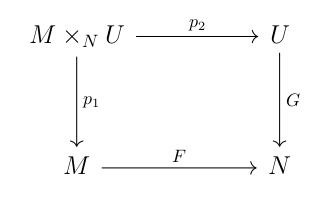 As \(G:U\rightarrow N\) is a submersion (we have started with this) and \(p_2: M\times_N U\rightarrow U\) is a submersion (we are given this), the composition \(G\circ p_2=F\circ p_1\) is a submersion which then imply that \(F:M\rightarrow N\) is a submersion.
Let \(m\in M\). As \(G:U\rightarrow N\) is surjective, so is \(p_1\) (pullback of surjective is surjective) i.e., there exists \((m,u)\in M\times_N U\) such that \(p_1(m,u)=m\).
As \(F\circ p_1\) is submersion, \((F\circ p_1)_{*,(m,u)}(T_{m,u}(M\times_N U))=T_{F(m)}N\). Applying chain rule, we have \(F_{*,m}((p_1)_{*,(m,u)}(T_{m,u}(M\times_N U)))=T_{F(m)}N\), in particular, \(F_{*,m}(T_mM)=T_{F(m)}N\). Thus, \(F\) is submersion. So, we need both surjectivity and submersion of \(U\rightarrow N\).
Now, let us look at more general case. Now, \(U\rightarrow N\) is not a surjective submersion but induces an epimorphism \(U\rightarrow N\). Suppose that the pullback \(M\times_N U\) is a manifold and that the map \(M\times_N U\rightarrow U\) is a submerson.
Let \(W\rightarrow N\) be a map. We need to prove that \(M\times_N W\) is a manifold. We have following diagram
As \(G:U\rightarrow N\) is a submersion (we have started with this) and \(p_2: M\times_N U\rightarrow U\) is a submersion (we are given this), the composition \(G\circ p_2=F\circ p_1\) is a submersion which then imply that \(F:M\rightarrow N\) is a submersion.
Let \(m\in M\). As \(G:U\rightarrow N\) is surjective, so is \(p_1\) (pullback of surjective is surjective) i.e., there exists \((m,u)\in M\times_N U\) such that \(p_1(m,u)=m\).
As \(F\circ p_1\) is submersion, \((F\circ p_1)_{*,(m,u)}(T_{m,u}(M\times_N U))=T_{F(m)}N\). Applying chain rule, we have \(F_{*,m}((p_1)_{*,(m,u)}(T_{m,u}(M\times_N U)))=T_{F(m)}N\), in particular, \(F_{*,m}(T_mM)=T_{F(m)}N\). Thus, \(F\) is submersion. So, we need both surjectivity and submersion of \(U\rightarrow N\).
Now, let us look at more general case. Now, \(U\rightarrow N\) is not a surjective submersion but induces an epimorphism \(U\rightarrow N\). Suppose that the pullback \(M\times_N U\) is a manifold and that the map \(M\times_N U\rightarrow U\) is a submerson.
Let \(W\rightarrow N\) be a map. We need to prove that \(M\times_N W\) is a manifold. We have following diagram  As \(M\times_N U\rightarrow U\) is a submersion, the pullback \((M\times_N U)\times_U W_i=M\times_N W_i\) is a manifold. So, we have an open cover \(\{W_i\rightarrow W\}\) of \(W\) such that the pullbacks \(M\times_N W_i\) are manifolds. I think this should confirm that \(M\times_N W\) is a manifold and just because \(M\times_N W\rightarrow W_i\) are submersions, so is the map \(M\times_N W\rightarrow W\). Thus, \(f:M\rightarrow N\) is a representable submersion.
The same idea works for an arbitrary map of stacks \(\mathcal{D}\rightarrow \mathcal{C}\).
Let \(\underline{W}\rightarrow \mathcal{C}\) be a map of stacks. We have to prove that \(\mathcal{D}\times_{\mathcal{C}}\underline{W}\) is representable and that the map of manifolds \(\mathcal{D}\times_{\mathcal{W}}\underline{W}\rightarrow W\) is a submersion.
As \(\underline{U}\rightarrow \mathcal{C}\) is epimorphism, for \(\underline{W}\rightarrow \mathcal{C}\) there exists an open cover \(\{W_i\rightarrow W\}\) with commutative diagram as shown below. We have following diagram
As \(M\times_N U\rightarrow U\) is a submersion, the pullback \((M\times_N U)\times_U W_i=M\times_N W_i\) is a manifold. So, we have an open cover \(\{W_i\rightarrow W\}\) of \(W\) such that the pullbacks \(M\times_N W_i\) are manifolds. I think this should confirm that \(M\times_N W\) is a manifold and just because \(M\times_N W\rightarrow W_i\) are submersions, so is the map \(M\times_N W\rightarrow W\). Thus, \(f:M\rightarrow N\) is a representable submersion.
The same idea works for an arbitrary map of stacks \(\mathcal{D}\rightarrow \mathcal{C}\).
Let \(\underline{W}\rightarrow \mathcal{C}\) be a map of stacks. We have to prove that \(\mathcal{D}\times_{\mathcal{C}}\underline{W}\) is representable and that the map of manifolds \(\mathcal{D}\times_{\mathcal{W}}\underline{W}\rightarrow W\) is a submersion.
As \(\underline{U}\rightarrow \mathcal{C}\) is epimorphism, for \(\underline{W}\rightarrow \mathcal{C}\) there exists an open cover \(\{W_i\rightarrow W\}\) with commutative diagram as shown below. We have following diagram
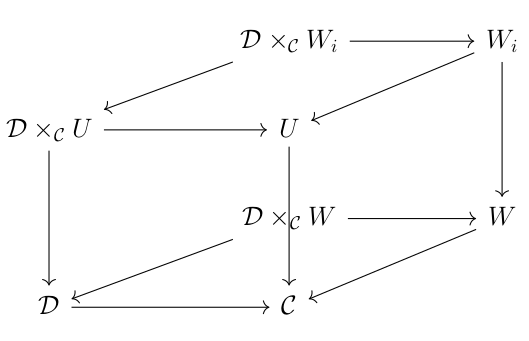 As \(\mathcal{D}\times_{\mathcal{C}} \underline{U}\rightarrow U\) is a submersion, the pullback \((\mathcal{D}\times_{\mathcal{C}} \underline{U})\times_U W_i=\mathcal{D}\times_{\mathcal{C}} W_i\) is a manifold.
So, we have an open cover \(\{W_i\rightarrow W\}\) of $ W$ such that the
As \(\mathcal{D}\times_{\mathcal{C}} \underline{U}\rightarrow U\) is a submersion, the pullback \((\mathcal{D}\times_{\mathcal{C}} \underline{U})\times_U W_i=\mathcal{D}\times_{\mathcal{C}} W_i\) is a manifold.
So, we have an open cover \(\{W_i\rightarrow W\}\) of $ W$ such that the
Let \(f:\mathcal{D}\rightarrow \mathcal{C}\) be a morphism of stacks. Suppose given a manifold \(U\) and a morphism of stacks \(\underline{U}\rightarrow \mathcal{C}\) which is an epimorphism. If the fibered product \(\mathcal{D}\times_{\mathcal{C}}\underline{U}\) is representable i.e., isomorphic to a stack coming from a manifold and that the map of manifolds \(\mathcal{D}\times_{\mathcal{C}}\underline{U}\rightarrow U\) is a submersion, then \(f\) is representable submersion.Let us see what this means in the set up of manifolds. Let \(f:\mathcal{D}\rightarrow \mathcal{C}\) be a morphism of stacks. Let \(f:M\rightarrow N\) be a morphism of manifolds (which gives a morphism of stacks \(\underline{M}\rightarrow \underline{N}\)). Suppose given a manifold \(U\) and a morphism of stacks \(\underline{U}\rightarrow \mathcal{C}\) which is an epimorphism. A representable surjective submersion is an epimorphism. So, we consider a surjective submersion \(g:U\rightarrow N\) (which gives an epimorphism \(\underline{U}\rightarrow \underline{N}\) being a representable surjective submersion). If the fibered product \(\mathcal{D}\times_{\mathcal{C}}\underline{U}\) is representable i.e., isomorphic to a stack coming from a manifold and that the map of manifolds \(\mathcal{D}\times_{\mathcal{C}}\underline{U}\rightarrow U\) is a submersion. As \(U\rightarrow N\) is submersion, it is anyways true that \(M\times_N U\) is a smooth manifold. What is extra that we have here is that \(M\times_NU\rightarrow U\) is a submersion. It is anyways true that \(M\times_NU\rightarrow M\) is a submersion being a pullback of submersion. But it is not true in general that \(M\times_NU\rightarrow U\) is a submersion. Here, we are given that \(M\times_NU\rightarrow U\) is a submersion. So,
Let \(f:\mathcal{D}\rightarrow \mathcal{C}\) be a morphism of stacks. Suppose given a manifold \(U\) and a morphism of stacks \(\underline{U}\rightarrow \mathcal{C}\) which is an epimorphism. If the fibered product \(\mathcal{D}\times_{\mathcal{C}}\underline{U}\) is representable i.e., isomorphic to a stack coming from a manifold and that the map of manifolds \(\mathcal{D}\times_{\mathcal{C}}\underline{U}\rightarrow U\) is a submersion, then \(f\) is representable submersion.turns to
Let \(f:M\rightarrow N\) be a morphism of manifolds be a morphism of manifolds. Suppose given a manifold \(U\) and a sujective submersion \(\underline{U}\rightarrow N\). If the fibered product \(M\times_{N}U\) is a manifold and that the map of manifolds \(M\times_{N}U\rightarrow U\) is a submersion, then \(f\) is submersion.This is more or less obvious. We have following commutative diagram
As \(G:U\rightarrow N\) is a submersion (we have started with this) and \(p_2: M\times_N U\rightarrow U\) is a submersion (we are given this), the composition \(G\circ p_2=F\circ p_1\) is a submersion which then imply that \(F:M\rightarrow N\) is a submersion.
Let \(m\in M\). As \(G:U\rightarrow N\) is surjective, so is \(p_1\) (pullback of surjective is surjective) i.e., there exists \((m,u)\in M\times_N U\) such that \(p_1(m,u)=m\).
As \(F\circ p_1\) is submersion, \((F\circ p_1)_{*,(m,u)}(T_{m,u}(M\times_N U))=T_{F(m)}N\). Applying chain rule, we have \(F_{*,m}((p_1)_{*,(m,u)}(T_{m,u}(M\times_N U)))=T_{F(m)}N\), in particular, \(F_{*,m}(T_mM)=T_{F(m)}N\). Thus, \(F\) is submersion. So, we need both surjectivity and submersion of \(U\rightarrow N\).
Now, let us look at more general case. Now, \(U\rightarrow N\) is not a surjective submersion but induces an epimorphism \(U\rightarrow N\). Suppose that the pullback \(M\times_N U\) is a manifold and that the map \(M\times_N U\rightarrow U\) is a submerson.
Let \(W\rightarrow N\) be a map. We need to prove that \(M\times_N W\) is a manifold. We have following diagram
As \(M\times_N U\rightarrow U\) is a submersion, the pullback \((M\times_N U)\times_U W_i=M\times_N W_i\) is a manifold. So, we have an open cover \(\{W_i\rightarrow W\}\) of \(W\) such that the pullbacks \(M\times_N W_i\) are manifolds. I think this should confirm that \(M\times_N W\) is a manifold and just because \(M\times_N W\rightarrow W_i\) are submersions, so is the map \(M\times_N W\rightarrow W\). Thus, \(f:M\rightarrow N\) is a representable submersion.
The same idea works for an arbitrary map of stacks \(\mathcal{D}\rightarrow \mathcal{C}\).
Let \(\underline{W}\rightarrow \mathcal{C}\) be a map of stacks. We have to prove that \(\mathcal{D}\times_{\mathcal{C}}\underline{W}\) is representable and that the map of manifolds \(\mathcal{D}\times_{\mathcal{W}}\underline{W}\rightarrow W\) is a submersion.
As \(\underline{U}\rightarrow \mathcal{C}\) is epimorphism, for \(\underline{W}\rightarrow \mathcal{C}\) there exists an open cover \(\{W_i\rightarrow W\}\) with commutative diagram as shown below. We have following diagram
As \(\mathcal{D}\times_{\mathcal{C}} \underline{U}\rightarrow U\) is a submersion, the pullback \((\mathcal{D}\times_{\mathcal{C}} \underline{U})\times_U W_i=\mathcal{D}\times_{\mathcal{C}} W_i\) is a manifold.
So, we have an open cover \(\{W_i\rightarrow W\}\) of $ W$ such that the\((\mathcal{D}\times_{\mathcal{C}}W)\times_W W_i=\mathcal{D}\times_{\mathcal{C}} W_i\)
are manifolds. By this question it follows that \(\mathcal{D}\times_{\mathcal{C}}\underline{W}\) is a manifold. For similar reason as mentioned in question, the map of manifolds \(\mathcal{D}\times_{\mathcal{C}}\underline{W}\rightarrow W\) is a submersion. Thus, \(\mathcal{D}\rightarrow \mathcal{C}\) is a representable submersion. Thus, we have following criterion for a map to be a representable submersion.Let \(f:\mathcal{D}\rightarrow \mathcal{C}\) be a morphism of stacks. Suppose given a manifold \(U\) and a morphism of stacks \(\underline{U}\rightarrow \mathcal{C}\) which is an epimorphism. If the fibered product \(\mathcal{D}\times_{\mathcal{C}}\underline{U}\) is representable i.e., isomorphic to a stack coming from a manifold and that the map of manifolds \(\mathcal{D}\times_{\mathcal{C}}\underline{U}\rightarrow U\) is a submersion, then \(f\) is representable submersion.